Context Wars
AI labs are competing to own the context that makes agents useful.
Matt Wolfe
Co-founder, Bidlo
Frontier model releases may be slowing, but the AI race is moving into a new phase: context. Matt Wolfe explains how Apple, Anthropic, and OpenAI are building around personal, conversational, and file-based context, then connects that shift to Bidlo’s view of market-aware AI for public construction.
The frontier model race is giving way to a quieter competition over context.
Apple is using personal ecosystem context to make Siri more useful inside everyday workflows.
Anthropic’s Claude-in-Slack direction shows how team conversations can become task-specific context.
OpenAI Codex points toward file and documentation context for long-running work across industries.
Bidlo frames public construction market data as context that agents can use for bidding, vendors, pricing, and opportunity discovery.
00:00 The hidden context war
00:27 Apple and personalized context
01:01 Claude in Slack and conversational context
01:56 Codex and file-based context
03:03 Turning market data into context
03:47 Why this matters next
Hey, I'm Matt, one of the developers at Bidlo, and today we'll be talking about the context war. It's this hidden work that's going on behind the scenes. I'm sure everyone's seen the news about GPT-5.6 being withheld from the general public just like Meta and Apple was after it was released. We are seeing a general slowdown in the speed at which frontier models are being released to the general public. This might change as more and more distilled versions of these models make their way through the open source community. However, the slowdown has shifted the focus to another work that's going on which is the context war. Apple did their big developer conference where they announced the new upcoming features.
The big focus of that conference was the next iteration of Siri, and they are now partnering with Google. A lot of the Gemini models will be underpinning the macOS and iOS operating systems, but their big push into this space isn't to make Siri the absolute frontier cutting-edge model. It's to give it all the context it needs to do what you want it to do. It understands how you talk to your grandmother, it understands your current weekly schedule, but understands your preferences in terms of shopping or app usage or things like that.
When you do ask to do something, its implementation is deeply personalized based on all the context that the Apple operating system or the Apple ecosystem is making available to that model. Now we can take that stuff further. This last week at Claude was introduced as a tag in Slack. Now I know a lot of people in our industry use Teams, but Slack is just the version of Teams used by developers. It is a wonderful platform, we really like that platform, and Anthropic has pushed to make that the user interface of the future for these models.
When you bring Claude in to any of your chats, any of your Teams for using that analogy, you're essentially giving that Claude bot access to all of your unstructured context, all of the conversation that goes on in that thread. And as you think about it, your organization has broken up into a lot of these threads. You'll have a thread specifically for I don't know, your estimating team or you might have a private conversation amongst a smaller subset of your estimating team. All of that is context that has been scoped to a very specific task or a very specific group.
And giving Claude access to those specific bubbles makes it that bot more aware of how it should act when you tell it to do things or aware of what's going on when you ask it to do things. This is just another example of one of these frontier labs in Anthropic, in this case, pursuing the context battle. The last implementation of this that I want to talk about is Codex, which is Claude code was in Anthropic's big foray into like a popular mainstream application. Codex is OpenAI's version of that. And well, and Anthropic is now focusing on the conversation part of context with its integration and does Slack. Codex is more focusing on like a file implementation.
Codex, you boot it on your computer, you tell it to get started on doing something and it's able to pull out, all of the information within that environment, through all the files, all the documentation, anything like that. Now OpenAI put out a really interesting article that showed Codex adoption over the last couple of months has skyrocketed, really since GPT-4.5 came out. The reason it has skyrocketed, when I said Skyrocketed, I'm not talking about within the developer community.
I'm talking about within all of the other industries, I'm talking about, the legal community, the medical community, all these other very file-focused communities that have been using apps like ChatGPT, but not the same to the same level with all the context awareness and all of the long running tasks that developers have been using through tools like Codex. So, well, Anthropic has been focusing on the conversational side of context and that's where they see this going. Anthropic has been focused on the conversation side of context. OpenAI has been focusing on files and the ability to map out a lot of unstructured data to get particular tasks done. That's their version of context.
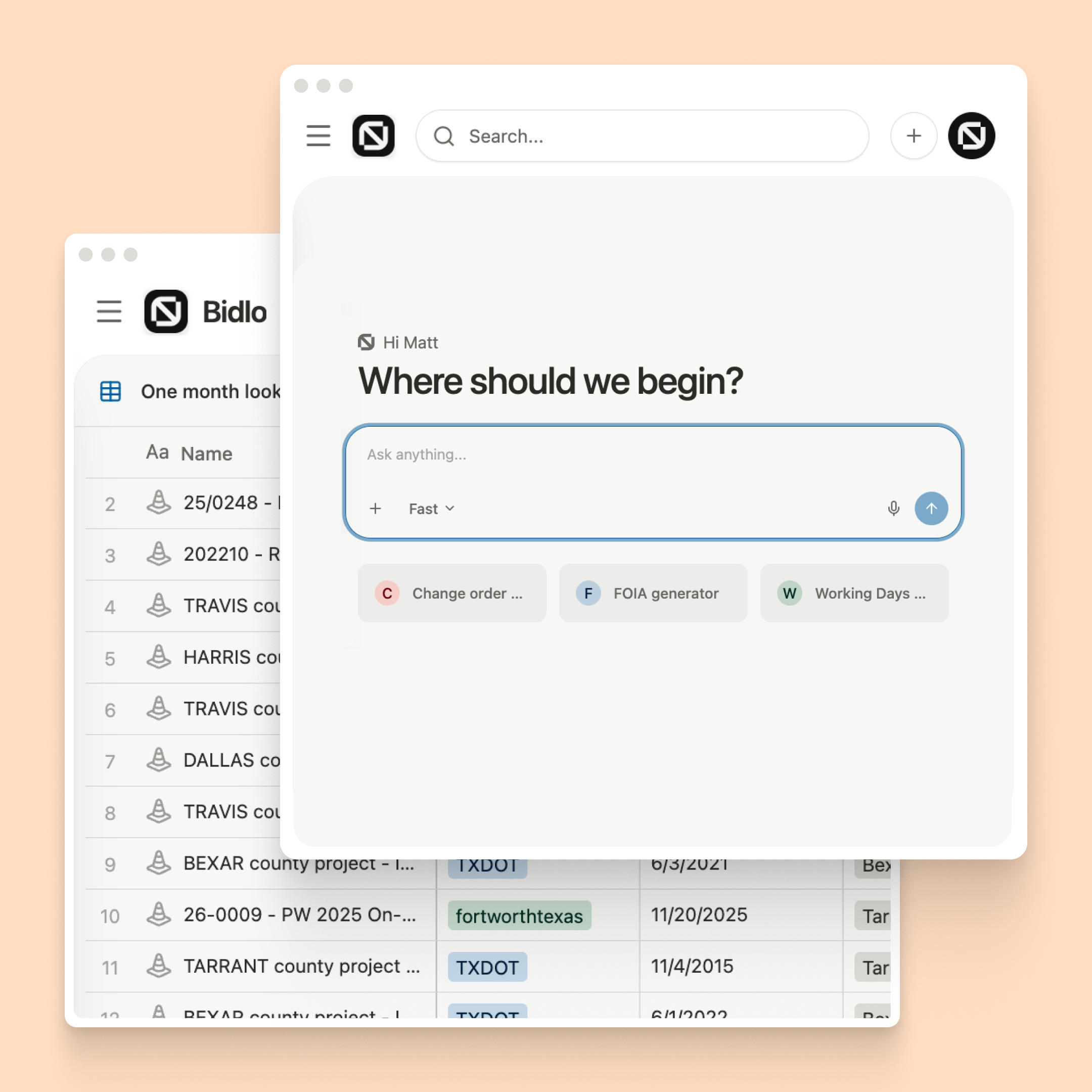
Now, we think all of these are to some degree right, depending on the workflow. At Bidlo, the way we are approaching this is we think of our product as a tool for turning your market into context. When you either launch any application or any conversation or any agent through Bidlo, it instantly has access to all of the other things that are going on outside of the project you are looking at. If you want to know bid pricing, if you want to know recommended vendors, it is aware of all that additional context in your market that is necessary to answer such a specific question on this project. Now, we think this is wonderful to do within Bidlo, but we also make that available to any of the agents you already use.
If your team is a Codex user or a Claude user, or maybe you build your own harnesses internally, we think that is fantastic and all of the data that we've turned into market aware context is available directly to that agent through MCP, APIs, or any of the other ways you'd like to integrate. That's the context war in a nutshell. A lot of that is going on under the mainstream media's radar. We say pay attention to that. I think this is going to become a very big topic over the next couple of months.